What Does Hreflang x-default Mean and When Is It Useful?
Generate language tags and check live alternates.
What Does hreflang x-default Mean?
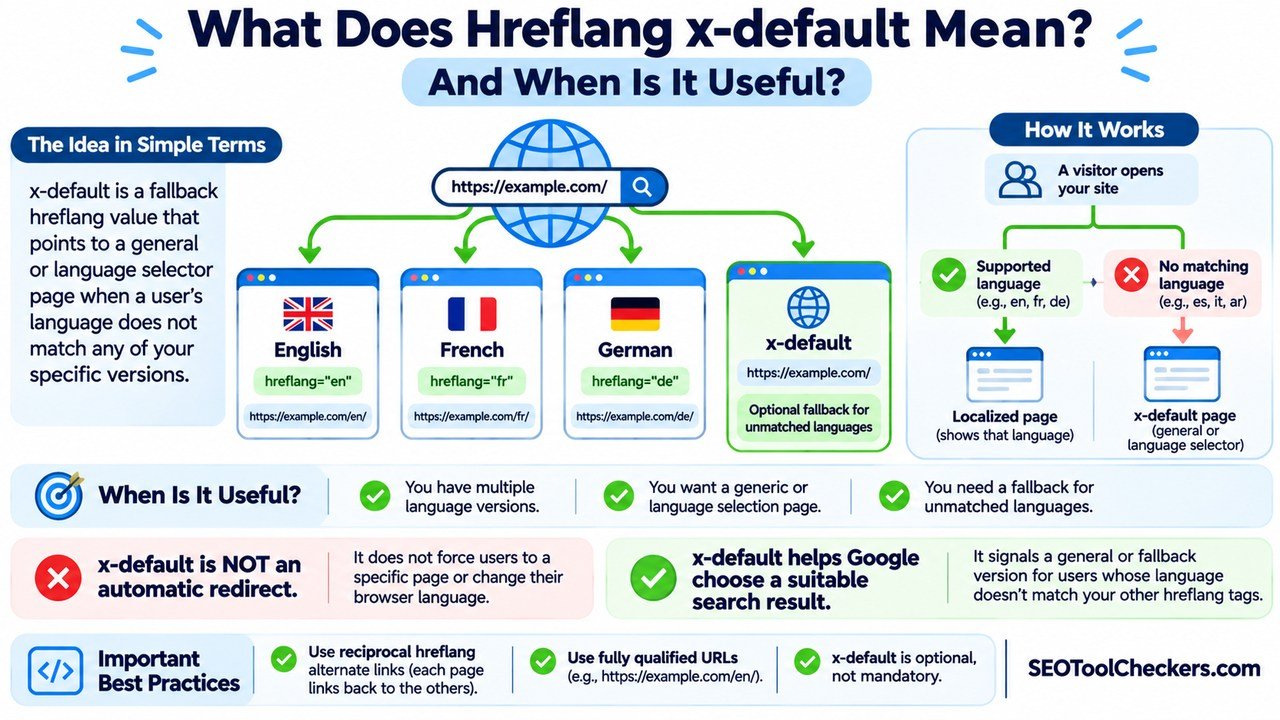
Hreflang x-default is an optional annotation that identifies a fallback page when none of a website’s specified language or regional versions matches a search user’s settings. It can point to a language selector, a global page, or an appropriate default-language version. Google uses this signal when choosing which URL to show in search results. It does not automatically redirect visitors or change their browser language, and its absence is not itself an indexing error.
Hreflang Generator and Checker
Generate language tags and check live alternates.
Generate hreflang tags
Use language or language-region codes (en, en-US, fr-FR) and absolute HTTP(S) URLs. Include every alternate, including the page itself, where appropriate.
Check published hreflang tags
Checks HTML and HTTP Link header declarations. Reciprocal page checks are limited by dashboard settings and may be disabled.
Choosing the Right Fallback URL for an International Website
Imagine a retailer that publishes equivalent help pages in English, French, and German. A visitor searching in Italian has no directly corresponding language version. Which URL should Google consider as the default? The x-default hreflang value helps answer that question without pretending the retailer has an Italian translation.
That is its specific job. It does not replace ordinary language tags, repair missing translations, or tell the server to move a visitor to a different address. The right destination depends on the page: a global selector can help users choose an available language, while a useful English page may be a better default for an article with no selector. Below is a worked example, the checks needed to keep alternate-page relationships consistent, and the difference between a fallback and a general-language URL.
What x-default tells Google—and what it does not
Regular hreflang annotations tell Google that several URLs are localized versions of comparable content. A page marked hreflang="en-GB" targets UK English; fr targets French speakers without restricting the region. The reserved value x-default is different: it names a URL intended for users whose language or region is not matched by the listed alternatives.
Google describes it as a fallback signal and recommends it particularly for language- or country-selection pages. A global homepage can serve this purpose for a set of corresponding homepages, but an article’s fallback should usually remain relevant to that article. Sending every localized product guide to an unrelated homepage may leave visitors unable to find the information they requested.
Hreflang affects search-result URL selection; it is not a redirect rule. If a user is forcibly sent elsewhere after opening a URL, investigate site-level redirects or scripts separately with the Bulk HTTP Status and Redirect Checker.
When should you use x-default?
The best candidate is a site with corresponding pages for several language or regional audiences but no matching version for every possible visitor. Consider three common situations.
- Language selector: A multilingual support site has a dedicated page listing available translations. Pointing
x-defaultto that selector gives unmatched visitors a clear choice. - Worldwide version: A retailer has US, UK, and French regional pages plus a global version that explains international availability. That worldwide page may be a suitable fallback.
- Default editorial language: A publisher offers German and English versions but no neutral selector. Its English article can legitimately serve as
x-defaultif that is the most useful available destination.
It is also reasonable to leave x-default out if there is no meaningful fallback. The presence of an x-default annotation is not a universal prerequisite for indexing or ranking.
x-default versus en: the difference many sites miss
Both can point to an English URL, but they express different intentions. en is a language declaration: the page serves English readers regardless of country. x-default is an unmatched-audience fallback: it is selected for situations not covered by the specific alternate values. If you have specific UK and US versions alongside a global English version, including both en and x-default may make sense.
| Value | What it describes | Useful destination |
|---|---|---|
en-US |
English for the United States | A US-specific help or product page |
en-GB |
English for the United Kingdom | A UK-specific version |
en |
English without a specific region | A general English-language version |
fr |
French regardless of region | A French-language version |
x-default |
Fallback for unmatched language or regional settings | A selector, worldwide page, or useful default version |
<html lang="en"> |
Document-language information in HTML | Not an alternate URL declaration |
For example, a single English page can appear twice in the same hreflang set, once with en and once with x-default, when it really serves both roles. However, do not label a language selector en merely because its interface includes a few English words. Use a language tag that matches the page’s substantive purpose.
A complete x-default HTML example with four URLs
Suppose a support company has one topic in English, French, and German, plus a topic-specific language selector. These fictional URLs are separate pages:
https://example.com/en/help/— English help.https://example.com/fr/aide/— French help.https://example.com/de/hilfe/— German help.https://example.com/help/languages/— a selector offering these versions.
The following block belongs inside the HTML <head> of each of those four pages. The selector page should also publish the same set so every listed destination identifies the alternate relationship:
<link rel="alternate" hreflang="en"
      href="https://example.com/en/help/">
<link rel="alternate" hreflang="fr"
      href="https://example.com/fr/aide/">
<link rel="alternate" hreflang="de"
      href="https://example.com/de/hilfe/">
<link rel="alternate" hreflang="x-default"
      href="https://example.com/help/languages/">
All destinations use full HTTPS URLs. The three translated pages cover the same topic, and the selector helps readers reach one of them. The selector is not a fictional Italian translation; it simply offers available choices. The markup is a documented pattern, not a guarantee that Google will show a particular result for every person or query.
For a group of regional homepages, a corresponding worldwide homepage may be the better fallback. For a single product manual, choose a manual selector or useful manual page instead of casually linking to the domain root.
Can x-default point to the same URL as en?
Yes. Imagine only English and German copies of a guide, with English being the company’s intended worldwide default. This shorter set is appropriate when both labels genuinely describe the English page:
<link rel="alternate" hreflang="en"
      href="https://example.com/en/guide/">
<link rel="alternate" hreflang="de"
      href="https://example.com/de/anleitung/">
<link rel="alternate" hreflang="x-default"
      href="https://example.com/en/guide/">
Put the same annotations on the English and German pages. The duplicate URL is intentional; the two annotations express separate purposes. Do not create a nonexistent selector page just to give x-default a unique address.
What you must check beyond the x-default line
Correct syntax is only one part of a useful implementation. An alternate group also needs accessible destinations, mutual references, and coherent canonical signals.
- Match corresponding content. Map each topic to the same topic in every language. A Spanish help page should not point to an English homepage merely because it is the site’s default URL.
- Include each page in its own list. Google instructs each language version to list itself and its alternates. When using a selector as a member of the set, keep its mapping consistent too.
- Confirm reciprocal links. If an English page identifies a French alternate, the French page should identify the English page. One-way declarations can be ignored for that pair.
- Use absolute, final URLs. Check protocol, hostname, case, and trailing slash. Avoid an outdated redirect as the declared destination.
- Check indexability and canonical choices. A localized page that is blocked, excluded, or canonicalized elsewhere may not behave as intended. Use the Canonical Tag Checker and Website Indexability Checker as supporting diagnostics.
- Validate output after publication. WordPress settings may look correct while caches, templates, or another SEO plugin produce a different tag set.
Do not confuse a canonical with a fallback. A canonical identifies a preferred URL among equivalent or duplicate URLs; x-default describes a default alternate. For separately useful translated pages, self-referencing canonicals are commonly appropriate, but always inspect the site-specific duplicate-content situation.
Common mistakes that make fallback targeting confusing
| Mistake | Why it is a problem | What to do |
|---|---|---|
Treating x-default as an automatic redirect |
Search-result selection and browser routing are separate mechanisms | Audit redirects separately; keep hreflang focused on alternate URLs |
| Pointing every article to the general homepage | The fallback may abandon the user’s original topic | Prefer an equivalent article or topic-level selector |
Using en-UK for UK English |
The correct UK region code is GB |
Use en-GB in regular hreflang annotations |
| Adding a different fallback on each translated page | The group sends inconsistent alternate-URL signals | Keep the intended alternate list aligned across the group |
| Omitting return links | Google may ignore unconfirmed alternate pairs | Make listed variants refer back appropriately |
| Using a URL that redirects, errors, or is blocked | The intended fallback may not be accessible | Use an appropriate reachable destination and fix technical barriers |
Using x-default instead of en |
It does not explicitly express general English targeting | Add en separately if a page genuinely serves all English speakers |
How to check hreflang x-default in WordPress
Begin with one language group, not every URL on the website. In a multilingual SEO plugin, confirm the English, French, German, and fallback destinations correspond to the same piece of content. Some integrations automatically generate hreflang in the page head, while others use sitemaps or custom theme code. Avoid publishing competing annotations from two plugins.
- Open a representative localized page and inspect the actual HTML source or response for
rel="alternate"entries. - Check that
hreflang="x-default"points to a real, useful fallback URL and that the regular locale tags are correct. - Inspect the other language pages and verify matching alternate maps and reciprocal references.
- Use the Hreflang Generator and Checker for the planned hreflang workflow; confirm its live input and output capabilities before depending on any particular checker feature.
- Check redirect status if the fallback jumps elsewhere, and inspect robots or canonical settings if an alternate cannot be indexed. The Robots.txt Generator and Tester can support the crawling-restriction review.
- Use Google Search Console URL Inspection to evaluate representative live pages and their indexing signals, remembering that a successful live test does not guarantee indexing or a specific localized ranking.
If scripts add or change tags after the page loads, compare source and rendered markup with the Source vs Rendered HTML Comparison. When alternate links live in XML rather than HTML, the XML Sitemap Validator can help inspect the sitemap syntax; it cannot by itself prove Google chose the intended fallback.
Should you put x-default in HTML, HTTP headers, or XML sitemaps?
Google accepts hreflang declarations in HTML <link> elements, HTTP Link headers, or XML sitemap alternate links. These methods are equivalent for expressing language variants. You do not have to implement all three, and redundant systems can make maintenance harder. HTML is often convenient for normal pages; response headers are useful for non-HTML documents; sitemaps can centralize a large catalog.
Whatever method you choose, consistently map the alternate URLs and keep the fallback relevant. For an XML implementation, check that each URL entry identifies its intended variants rather than assuming a single declaration covers an entire site. If you need to review exported site URLs before building that map, use the Sitemap URL Extractor to organize the inputs.
Quick questions about x-default
Is hreflang x-default required?
No. Google recommends a relevant fallback for unmatched languages, but x-default is optional. Its absence is not automatically a technical error.
Does x-default mean all countries?
Not exactly. It signals a fallback when more specific declared language or region values do not match. A general-language tag such as en makes a separate statement about English content regardless of country.
Can a language selector be the fallback?
Yes. Google designed the value with language-selection pages especially in mind. A selector should offer real destinations and allow visitors to choose freely.
Will Google always show the x-default URL to unmatched visitors?
No. Hreflang is a signal for selecting appropriate search-result URLs, not a promise about every query or an instruction to redirect everyone.
Can I use x-default without translations?
Without genuine alternate versions, a hreflang cluster generally has little purpose. Publish alternate annotations when there are corresponding localized URLs, then decide whether a fallback is helpful.
Should the fallback always be the homepage?
No. For a group of equivalent articles or product pages, a related page or topic-specific selector is usually more useful than a generic homepage.
The best fallback is the one that preserves the visitor’s purpose
Start with actual localized versions, not the markup. Identify what someone needs when their language is unavailable: a clear selector, a worldwide version, or the site’s most useful default-language page. Add x-default only when that choice is real. Then ensure your pages consistently declare each other, resolve to appropriate indexable URLs, and remain usable without unexpected redirects. That is more valuable than adding an extra line of hreflang to every template without checking where it leads.