Normalize Keyword Lists Without Deleting Useful Variants

How do you normalize a keyword list without losing valuable variants?
Normalize a keyword list by removing formatting-based duplicates first, then reviewing wording differences instead of deleting them automatically. Capitalization and repeated spaces can often be standardized for comparison, but plurals, synonyms, brands, locations, prices and other modifiers may reveal different search needs. Keep the original query, a normalized comparison key and an intent group in separate columns. This creates a manageable list without discarding potentially useful keyword evidence.
A keyword export can contain hundreds of rows that look almost identical. You might see “SEO Tool,” “seo tool,” “seo tools,” “free seo tool” and “seo tool for beginners” together. Some are formatting duplicates. Others may deserve their own section, page, or audience research.
The mistake is treating every similar phrase as disposable. Start with a reversible cleanup using the Keyword List Cleaner, but retain your untouched source export. The goal is not the smallest possible spreadsheet. It is a reliable keyword inventory that remains useful for SEO analysis, search-intent research and content planning.
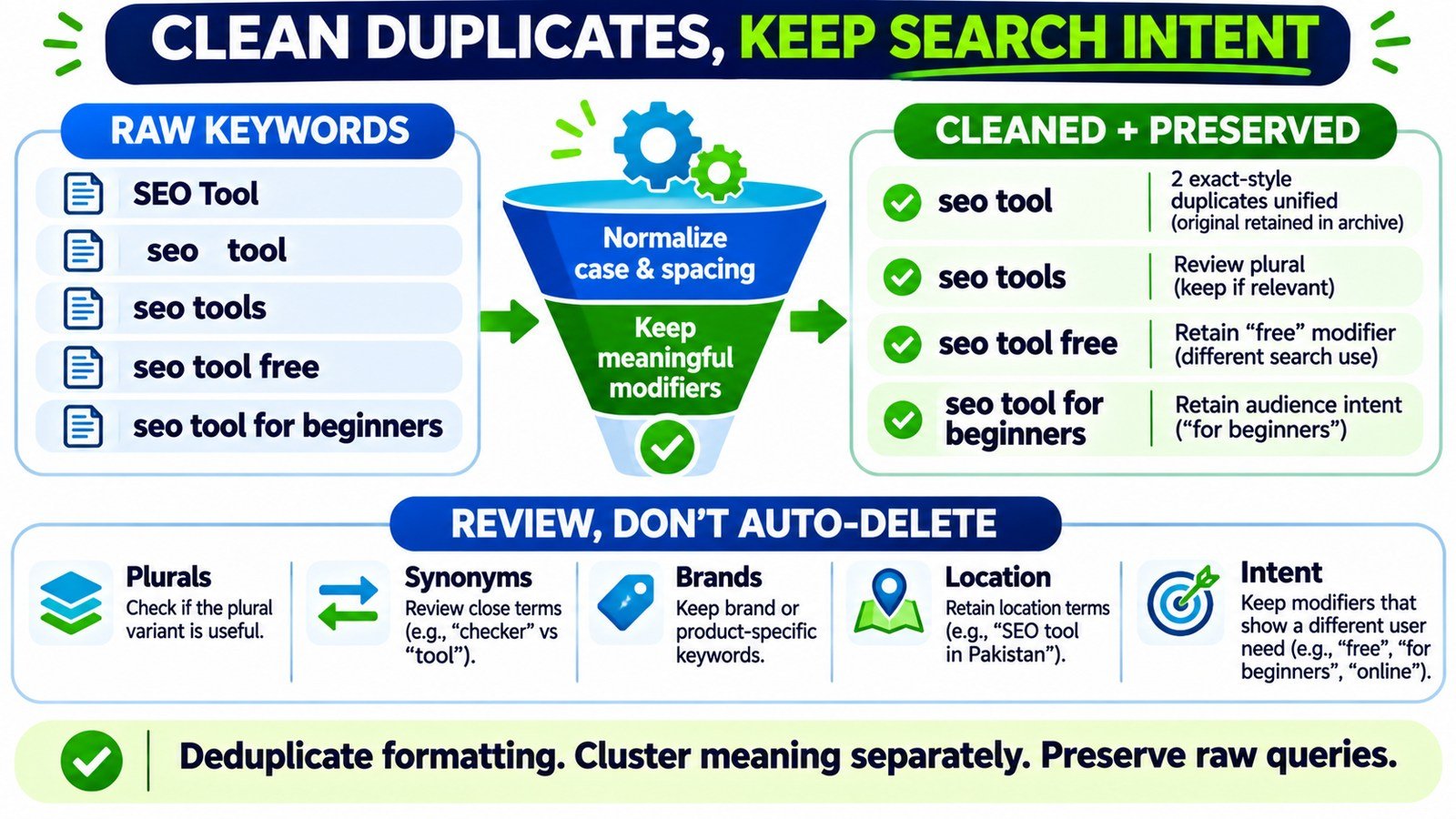
After retaining meaningful variations, use the resulting topic groups to build a content brief from a keyword-to-page map.
Three different jobs are often confused
Keyword normalization, deduplication and clustering solve related but different problems:
- Normalization creates a consistent comparison format, such as trimming extra spaces and applying a standard case to an auxiliary key.
- Deduplication identifies rows that represent the same item under a defined matching rule. It does not necessarily justify deleting their original records.
- Clustering groups different queries that may share a search intent or fit the same landing page. A cluster can and often should contain multiple distinct phrases.
For example, “seo tool” and “ SEO tool ” can share one normalized key. “seo tool” and “free seo tool” should not automatically become one record: the second query adds a price requirement. They might later belong to the same content cluster, but that is a different decision. Use the Keyword List Grouper for this second-stage analysis rather than using a destructive find-and-replace rule.
What can you safely clean, and what requires judgment?
Use a conservative policy. Some transformations are generally reasonable for matching, while others can quietly remove meaningful search signals.
| Variation | Recommended action | Reason |
|---|---|---|
| Leading/trailing spaces | Normalize comparison key | Usually a copy/paste artifact, not a different query. |
| Repeated internal spaces | Normalize comparison key | Often harmless formatting noise; retain raw text separately. |
| Capitalization | Usually normalize for matching; flag exceptions | Brands, product codes and acronyms may need original casing preserved. |
| Singular and plural | Review or cluster | They may share intent, but that is not guaranteed. |
| Typos and accents | Review before combining | Common misspellings may be useful; accents can matter by language or name. |
| Synonyms and reordered phrases | Cluster by intent, not text alone | Similar wording does not guarantee identical search results. |
| Free, price, near me, city, model | Preserve as variants | These modifiers can signal different needs or audiences. |
| Technical punctuation | Preserve unless checked | “C” and “C++,” or model identifiers with hyphens, are not interchangeable. |
Do not blindly remove stop words or punctuation. “Flights to London” and “flights from London” point in different directions. A simplistic rule that deletes “to” and “from” would destroy that distinction. Likewise, stripping every symbol can collapse technical product names into unrelated terms.
Set up a reversible four-column keyword inventory
Keep enough information to inspect every transformation. A small, consistent schema prevents accidental losses as a list passes between a cleaner, a grouping tool and a content planner.
- Original query: The exact text from your source, unchanged.
- Normalized key: A comparison-only version with agreed formatting cleanup.
- Review status: Exact duplicate, retained variant, possible cluster or manual review.
- Intent/page group: The page or topic the query should support, assigned after reviewing meaning.
Add source, market, date, search type, and metrics columns when they exist. These are especially important for Google Search Console data: a query measured on mobile in one country is not always interchangeable with the same text measured on desktop in another country. Preserve the measurement dimensions rather than combining unrelated rows.
You can create a basic comparison key in a spreadsheet with the formula =LOWER(TRIM(CLEAN(A2))). This removes many common spacing and control-character problems, but it is not a universal language-aware normalizer. It does not reliably handle every non-breaking space, Unicode character or punctuation rule. Keep the original in column A, test unusual characters and handle protected brand terms separately.
A practical example: nine related searches, different decisions
Consider this illustrative list for a site publishing articles about SEO utilities. The decisions below show a conservative editorial workflow, not the output of a live tool or a real dataset.
| Original query | Normalized comparison | Decision |
|---|---|---|
| SEO Tool | seo tool | Keep as representative. |
| seo tool | seo tool | Mark formatting duplicate; retain original in archive. |
| SEO tools | seo tools | Keep; review plural intent. |
| free seo tool | free seo tool | Keep “free” requirement. |
| seo tool free | seo tool free | Possible cluster with “free seo tool”; no automatic deletion. |
| seo tool for beginners | seo tool for beginners | Keep audience modifier. |
| seo tool pricing | seo tool pricing | Keep commercial/pricing intent. |
| seo tool in Pakistan | seo tool in pakistan | Keep geographic modifier. |
| C++ SEO checker | c++ seo checker | Keep technical punctuation; verify topic relevance. |
Only the first two rows are a straightforward formatting-duplicate pair under this chosen policy. The others are candidates for grouping or separate treatment. A keyword with unusual wording can be irrelevant, ambiguous, or highly valuable; text cleanup alone cannot decide which.
A seven-step workflow for cleaning a real keyword export
- Back up the input. Save the raw CSV or spreadsheet with its original column names and metadata. Keep a second file for processing so every merge can be reversed.
- Define the matching rule. Decide whether you will trim whitespace, collapse repeated spaces, standardize case or address known encoding issues. Record the rule so future exports are handled consistently.
- Build comparison keys. Apply the agreed formatting steps to a new column. Do not overwrite query text or casually remove symbols, units, model numbers or geographic names.
- Mark exact-style duplicates. Compare normalized keys within the same relevant dataset dimensions. Retain one representative in the working list and preserve all source rows in your archive.
- Inspect semantic variants. Sort by related terms, review plurals and close synonyms, and examine modifiers such as “best,” “free,” “how to,” “buy,” and “near me.” An N-gram Keyword Analyzer can help reveal recurring word combinations, but phrase frequency is not proof that queries share intent.
- Assign clusters and target pages. Compare the purpose and search results for representative queries. Use the Keyword-to-Page Mapping Tool to plan primary and supporting terms for each intended page.
- Audit the result. Count source rows, formatting duplicates, unique normalized keys, retained variants and unresolved cases. Sample several groups manually before making editorial or URL decisions.
For large datasets, use a review queue rather than forcing every uncertain phrase into one cluster. A “manual review” state is a quality-control feature, not a failure of automation.
Why Google Search Console queries need extra care
Google Search Console helps reveal real phrases that led to impressions and clicks for your site, but its reporting has important boundaries. Its query filters are generally case-insensitive, and the performance report may omit anonymized queries or truncate low-priority rows. Consequently, an exported keyword list is not necessarily a complete record of every search.
If you export query data, retain the reporting period and filters. A Search Console CSV Comparison Analyzer can support analysis of comparable exports, while a Search Console Regex Builder and Tester can help formulate query filters for consistent segments. These tools do not replace an understanding of Search Console’s reporting limitations.
Do not sum incompatible metrics. If exact duplicate text appears in separate country or device segments, the rows may represent different measurements. If you legitimately aggregate clicks or impressions across disjoint groups, recompute CTR as total clicks divided by total impressions. Do not add CTR percentages together or take an unweighted average of average positions.
Preserve meaning when mapping branded and non-branded terms
Brand and product names deserve explicit handling. A phrase containing your own company may indicate navigation or customer support; a competitor name may reflect comparison research; an ordinary word that matches a brand can be ambiguous. The Branded vs Non-Branded Query Classifier is the appropriate companion when separating these groups. Your brand dictionary should include confirmed aliases, product names and known ambiguity cases.
Apply the same caution to locations. “SEO tools” and “SEO tools in Lahore” might eventually point to one useful page, but the location phrase should remain visible in research. Otherwise you cannot evaluate whether local intent deserves its own section, example or landing page.
When one cleaned cluster should not become one page
A group of similar keywords is only a planning hypothesis. Two terms may share words while requiring different content formats. “Keyword cleaner” suggests a working utility; “how to clean keyword lists” suggests a tutorial. Sometimes a tool page and a supporting educational article should both exist, with clear internal links between them.
Before creating or merging pages, check whether the existing pages answer distinct questions, attract different queries, and have useful content worth retaining. The Keyword Cannibalization Analyzer is a relevant follow-up for investigating overlapping page targets, but repeated keywords alone do not prove harmful cannibalization. Compare intent and page performance before consolidating content or redirecting URLs.
Quality checks before you approve the cleaned list
- Every retained keyword can be traced to its original source row.
- No brand, product code, programming language or location was changed accidentally.
- Exact-style duplicates are separated from plausible synonym clusters.
- Important modifiers such as “free,” “pricing,” “near me,” and “for beginners” survive.
- Metrics are kept with their country, device, date and source definitions.
- Uncertain groupings are flagged instead of deleted or forced together.
- Every target page has a clear user task rather than merely a shared keyword stem.
One helpful audit is to compare your raw export with a table listing each normalized key and its associated original variants. If a cleaned key suddenly absorbs unrelated terms, examine the transformation rule that created it. A shorter file is not proof of a better one.
Common questions about keyword normalization
Should I remove singular and plural keyword variations?
Not automatically. Record both, then check whether they express the same need. They may share a page target, but keeping the separate phrases helps preserve research evidence and potential audience differences.
Can I merge synonyms into one keyword?
It is better to group them while retaining their original text. Synonyms can have different commercial, informational or local intent. Compare representative search results before treating them as interchangeable.
Does Google Search Console already remove all duplicates?
Its query reporting groups data according to its own dimensions and rules, and query filtering is case-insensitive. That is not the same as an editorial keyword normalization process. Exports can omit anonymized queries and do not make intent-based clustering decisions for you.
Should I delete keywords with zero search volume?
No. A third-party zero or very low estimate is not conclusive proof that a phrase has no value. Keep relevant long-tail terms when they answer real questions, support conversions, or clarify a page’s intended audience.
Is keyword normalization the same as preventing cannibalization?
No. Normalization cleans comparison data; cannibalization analysis examines page overlap and performance. You can have an immaculate keyword sheet and still map several pages to the same user task.
The rule worth keeping
Standardize formatting, preserve original wording, and group only after reviewing intent. Keyword cleanup should reduce administrative noise without erasing the phrases people actually use. A reversible process gives you both: a dependable working list and enough detail to build accurate content briefs, compare Search Console data, and choose pages with confidence.