Find Content Gaps Using Phrase Frequency Without Keyword Stuffing
How can phrase frequency reveal content gaps without keyword stuffing?
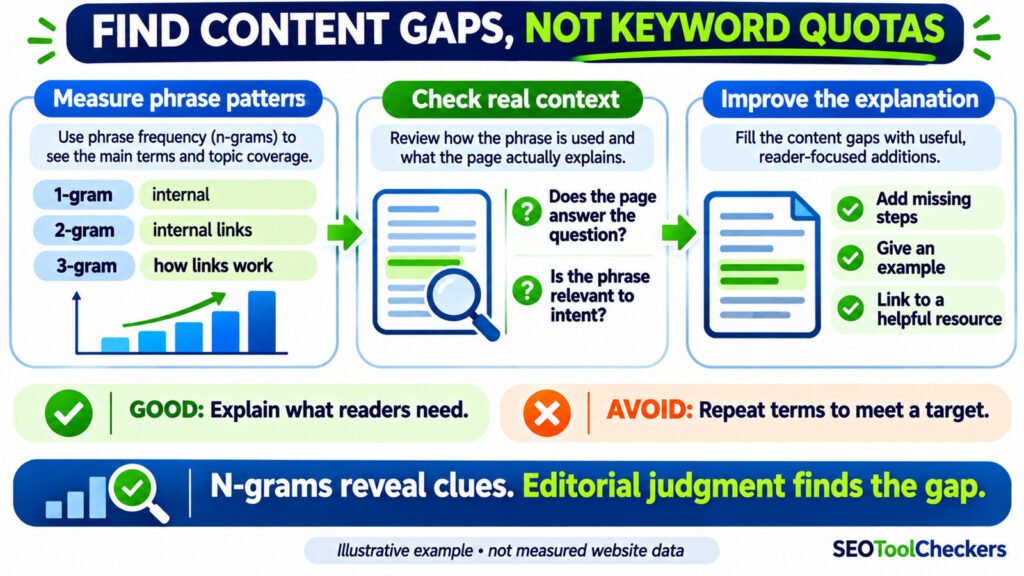
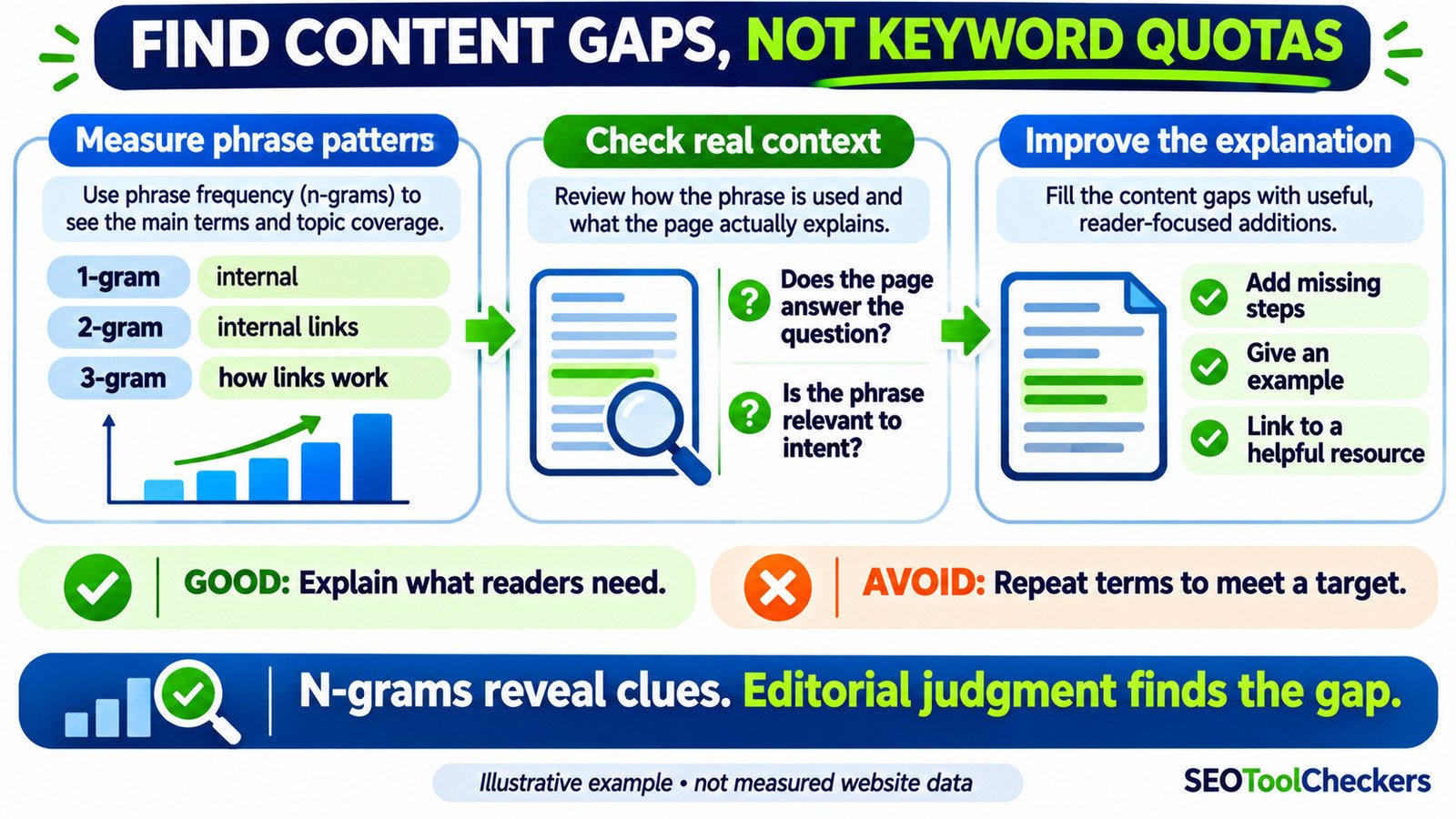
Compare the one-, two-, and three-word phrases in your page with those found in relevant reference material. Treat unusually absent phrases as questions to investigate, not words you must insert. Read the surrounding context, confirm that the topic matters to your audience, and add an explanation, example, or step only where it solves a real problem. N-gram counts reveal wording patterns; editorial judgment determines whether a content gap exists.
Repeated phrases can help you see which subjects a page discusses and which ones it may have missed. They can also be misleading. A phrase appearing twelve times on another website does not mean your page needs twelve mentions, or even one. A useful content gap is a missing answer, not a difference between two keyword counts.
Suppose you have written a guide to auditing internal links. A comparison reveals frequent references to “orphan pages” in other relevant guides, while your article barely explains how to find pages with no internal links. That is worth investigating. If the comparison instead reveals “buy backlinks,” a phrase unrelated to the reader’s internal-link audit, copying it would weaken the guide.
When you identify a real missing explanation, capture its reader questions and evidence requirements in a content brief built from the keyword map.
The N-gram Keyword Analyzer can support this kind of phrase-level review. The workflow below explains what to compare, how to interpret a result, and when to leave your article alone. All numbers in the worked examples are illustrative rather than observations from a live website or a tool test.
What an N-gram tells you, and what it cannot tell you
An N-gram is a sequence of n consecutive tokens in a piece of text. A one-gram usually represents one word; a two-gram contains two consecutive words; a three-gram contains three. For the sentence “internal links help discovery,” possible two-grams are “internal links,” “links help,” and “help discovery.” The precise output depends on how the analyzer treats punctuation, capitalization and token boundaries.
| Measure | Illustrative example | Useful interpretation | Important limitation |
|---|---|---|---|
| 1-gram | links | Highlights a repeatedly discussed term. | Too broad to reveal the reader’s task on its own. |
| 2-gram | internal links | Identifies a recognizable concept. | Its presence does not prove the concept is explained well. |
| 3-gram | find orphan pages | Can suggest a specific action or unanswered question. | Different wording may communicate the same idea. |
| Phrase frequency | “internal links” appears eight times | Shows repetition within the text analyzed. | Counts vary with document length and included navigation. |
| Document frequency | Three of four guides mention a phrase | Shows how widespread a phrase is across the sample. | A common phrase is not automatically necessary for every page. |
Two sources can explain the same topic using different words. “Pages without inbound internal links” and “orphan pages” may refer to the same underlying issue. Likewise, a page can repeat “crawlability” often without explaining how a website owner should check it. Frequency measures language, not completeness, relevance, expertise or ranking potential.
Prepare a fair comparison before looking for gaps
The quality of your source material determines whether the N-gram report is informative. Compare documents that fulfill a similar purpose. A tutorial on auditing links should not be judged against a sales landing page for a link-building agency or a glossary entry about hyperlink history.
- Choose one target page and one reader task. Define what the article promises to help someone do. Keep that promise visible throughout the review.
- Collect a small, relevant reference set. Review several credible pages, technical documentation and real user questions relevant to that same task. Do not assume the highest-ranking result is the most accurate.
- Compare main content, not website chrome. If possible, remove menus, repeated footers, cookie notices and unrelated suggested articles from each sample. These can inflate counts for generic terms.
- Keep language and document type comparable. Differences in language, audience, text length and format can distort the results. A short answer will naturally have fewer repeated phrases than a long tutorial.
- Save your original material. Keep the page text, source labels and analysis date so you can reproduce the editorial decision. For third-party sources, use them for research rather than copying their prose.
If your raw keyword exports contain capitalization or spacing duplicates, use the Keyword List Cleaner to tidy the list while retaining meaningful variants. Cleaning an input list is not the same as merging all semantically related phrases or declaring them interchangeable.
A repeatable six-step phrase-frequency gap audit
- Establish the existing coverage. Read the target page first. Record its main promise, section headings and practical examples. This is the baseline against which proposed additions must be judged.
- Extract one-, two-, and three-word phrases. Run the comparable content through the N-gram Keyword Analyzer or an equivalent transparent method. Record the exact text used and whether the output counts occurrences or unique documents.
- Remove noise. Ignore navigation phrases, stopword-heavy combinations, brands unrelated to your topic, repetitive boilerplate and strings created by inconsistent punctuation. Do not assume that removing every common word improves the analysis; context sometimes depends on it.
- Prioritize questions, not counts. For each potentially missing phrase, ask what question it represents. Inspect at least one meaningful reference passage, then check whether your own page already answers the question in different language.
- Choose the right editorial action. Add a short answer, an example, a step, a comparison or a helpful link when a real gap remains. If the question belongs to another search intent, retain the present scope and consider a distinct page instead.
- Read and verify the revision. Remove awkward repetition, check every factual claim, verify the new material fits the article’s flow, and confirm you have not created an overlapping section that already exists elsewhere.
A separate Keyword Density Checker can help flag repeated wording for an editorial read-through. Its percentages should not become a required target. Google does not publish a universal density percentage that makes a page rank, and hitting a particular number is not evidence of useful content.
Worked example: an internal-link guide with missing explanations
Consider a fictional site with a page titled “How to Audit Internal Links.” The writer compares it with three relevant instructional references. The table below shows made-up phrase coverage to demonstrate decisions, not measured results from the web or SEOToolCheckers tools.
| Phrase | Your page | References mentioning it | Editorial decision |
|---|---|---|---|
| internal links | Already discussed | 3 of 3 | Keep the explanation; no need to increase repetition. |
| orphan pages | Not covered | 3 of 3 | Investigate whether readers need a detection step. |
| descriptive anchor text | Briefly mentioned | 2 of 3 | Consider a practical good-versus-vague anchor example. |
| crawl discovery | Not covered | 2 of 3 | Explain discovery limits if relevant to the auditing workflow. |
| buy backlinks | Not covered | 2 of 3 | Reject; this is a different topic and reader task. |
The strongest candidate is not necessarily the phrase that appears most often. “Orphan pages” may reveal a genuine blind spot: the guide never shows how to identify pages that lack discoverable internal links. The fix would be a concise explanation of what an orphan page is, the limitations of a crawl-only audit, and a useful verification step. Repeating “orphan pages” in every heading would not fix the omission.
For anchor text, the writer may add a simple comparison: “read more” gives little context, while “check an internal-link audit report” describes the linked resource. A relevant next step is to examine existing links with the Internal Links and Anchor Text Analyzer. That link helps the reader act on the explanation rather than functioning as another keyword insertion.
Rewrite the missing answer rather than inserting the missing phrase
Compare two ways of responding to an N-gram alert for “orphan pages.” The first is mechanical and does not help anyone:
Orphan pages matter in an orphan pages audit. Find orphan pages because orphan pages create orphan page problems.
A useful revision would instead say:
An orphan page is a page with no discoverable internal links from other pages in the set you examined. Start with a list of known URLs, such as your sitemap and analytics landing pages, then compare it with URLs found by your internal-link crawl. Review unmatched URLs manually: a crawler may miss links due to rendering, permissions or crawl scope.
The revised passage adds a definition, a method and a limitation. It makes the article more practical without imposing any phrase quota. The language also remains natural even if another writer would choose different wording.
When several phrases point to the same underlying question, group them into one editorial task using the Keyword List Grouper. Do not make a separate H2 for every closely related string. One well-developed section can address multiple natural ways to describe the same problem.
Validate content gaps against search intent and Search Console
N-gram output shows what appears in a selected text sample. It does not show what visitors to your website searched for, which results they saw, or whether a content change would improve clicks. Search Console can offer additional context for existing pages.
In Google Search Console’s Performance report, choose a suitable date range, filter to the intended URL, and examine visible queries, impressions, clicks and CTR. Look for questions connected to a proposed gap. A page already receiving impressions for “find orphan pages” may warrant a closer editorial review if that task is poorly answered. A query with little or no visible data should not automatically be discarded.
Remember that Search Console query tables may omit anonymized queries and truncate rows. Its results are a partial view of search visibility rather than an exhaustive inventory of every query. If you are comparing exports from two time periods, the Search Console CSV Comparison Analyzer is a relevant companion to the manual review; ensure the compared periods, filters and exports are consistent before interpreting differences.
Once you identify a useful new subsection, confirm page ownership. If an existing guide already covers that question fully, it may be better to link to it than to duplicate the whole explanation. The Keyword-to-Page Mapping Tool helps organize topic assignments and planned URLs, but editorial search-intent review remains essential.
Which phrase-frequency findings should you ignore?
High counts are common in repeated menus, product names, comparison tables and copied templates. They may reflect page structure rather than the needs of a searcher. Equally, a missing exact phrase may be irrelevant because your article already explains the concept using a synonym. Avoid additions when:
- The phrase belongs to a different task, audience or search intent.
- Your current explanation is already complete, even though its wording differs.
- The phrase appears mainly in navigation, legal boilerplate, repeated cards or advertisements.
- You cannot verify the factual claim that the new section would require.
- The topic deserves a separate page rather than an unrelated detour.
- The only reason to add text is to hit a count, percentage or presumed ranking formula.
For a focused before-and-after editorial review, the Text Comparison Tool can help you examine changed wording. Still judge whether the change made the answer more useful: text difference is not the same as content improvement.
How to know whether the revised page is better
First evaluate outcomes a reader can actually experience. Does the revised section answer a previously unanswered question? Can someone follow the instructions? Are the examples reproducible and the limitations clear? Is the page still easy to scan? Those are immediate editorial tests.
After publishing, document the revision date and review comparable Search Console periods with similar search type, device, country and seasonal context. Some changes may help readers without producing an observable ranking shift, and rankings can move for unrelated reasons. Do not credit an improvement—or blame a decline—on a single phrase added to a page.
Google’s people-first content guidance emphasizes useful original information and satisfying answers. Its spam policies specifically warn against unnatural keyword repetition intended to manipulate search results. Phrase-frequency research is compatible with those principles when it leads to genuinely better explanations instead of formulaic rewriting.
Common questions about N-gram content-gap analysis
Is there an ideal keyword density for SEO?
No universal target is established by Google. A density figure can help you spot awkward repetition, but it cannot establish whether an article is accurate, relevant or comprehensive. Edit for a natural answer, not a percentage.
Should I copy all frequent phrases from competing pages?
No. Use them to generate research questions. Keep only topics that are relevant to your reader’s task, verify the underlying information and explain it in original language.
Are two-word or three-word phrases better for finding gaps?
Neither is always better. One-grams can identify broad vocabulary; two-grams often expose concepts; three-grams can surface actions or questions. Use several lengths and inspect their contexts before drawing conclusions.
Does a missing N-gram mean my page is incomplete?
Not necessarily. Your page may answer the same question using different wording, or the phrase may be irrelevant. Confirm a missing reader-facing answer before treating a phrase as a content gap.
How often should I repeat the analysis?
Revisit it when the page’s purpose changes, new questions emerge, or an editorial review identifies weak explanations. There is no universal schedule, and constantly rewriting a page to match changing phrase counts is rarely useful.
Bottom line: Use phrase frequency to notice potential omissions, then investigate what the reader actually needs. A good content-gap audit ends with a clearer answer, a useful example or a better next step—not a longer list of repeated keywords.